At the Start of 2024, the Rental Housing Market Shows Mixed Signals (December 2023 Rental Market Report)
January 16, 2024 Evelyn Yang recommends
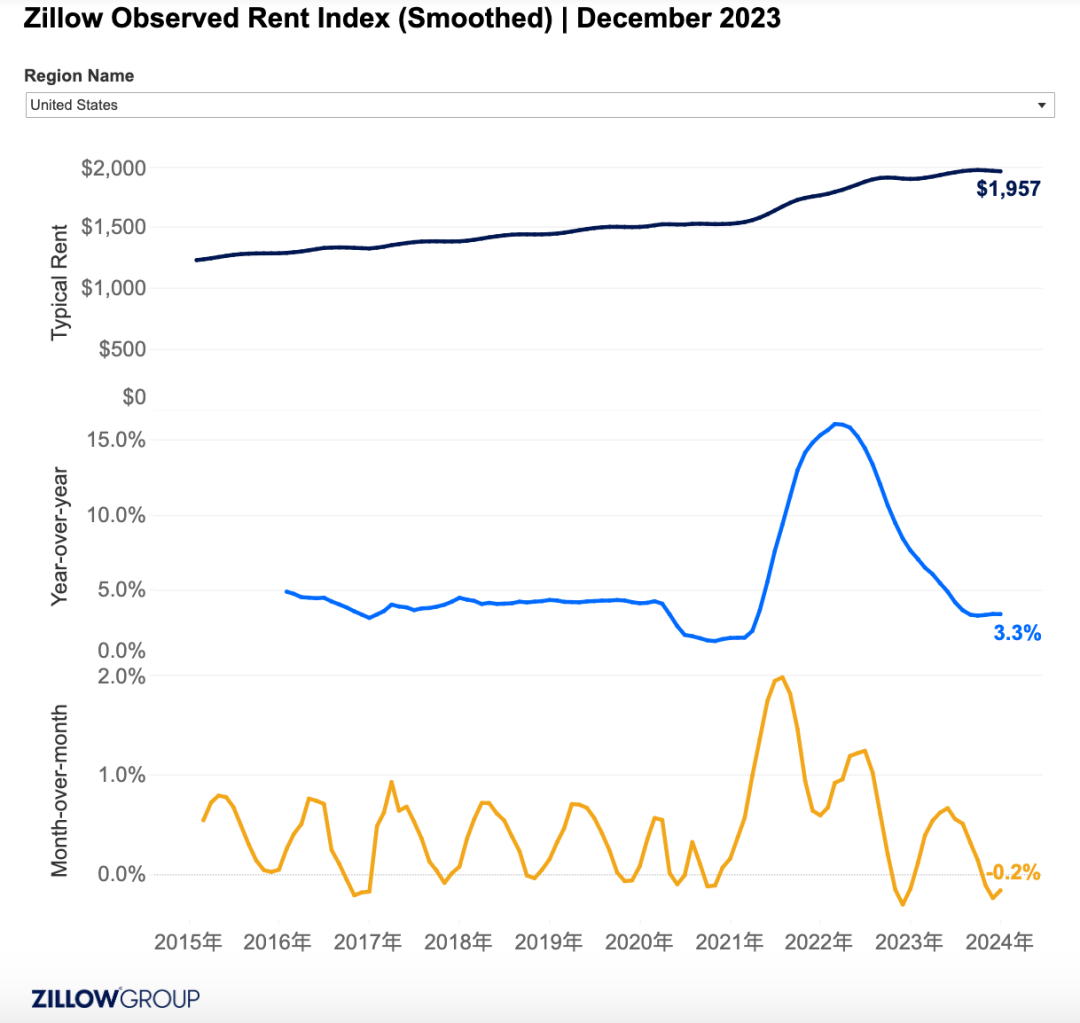
According to the Zillow Observed Rent Index (ZORI), the rental market showed signs of cooling in December, with the typical U.S. rent holding steady at $1,957. This was a slight decrease of 0.2% from the previous month, providing some relief for renters facing ongoing affordability challenges. However, despite the monthly decline, rents were still up 3.3% from the same period last year.
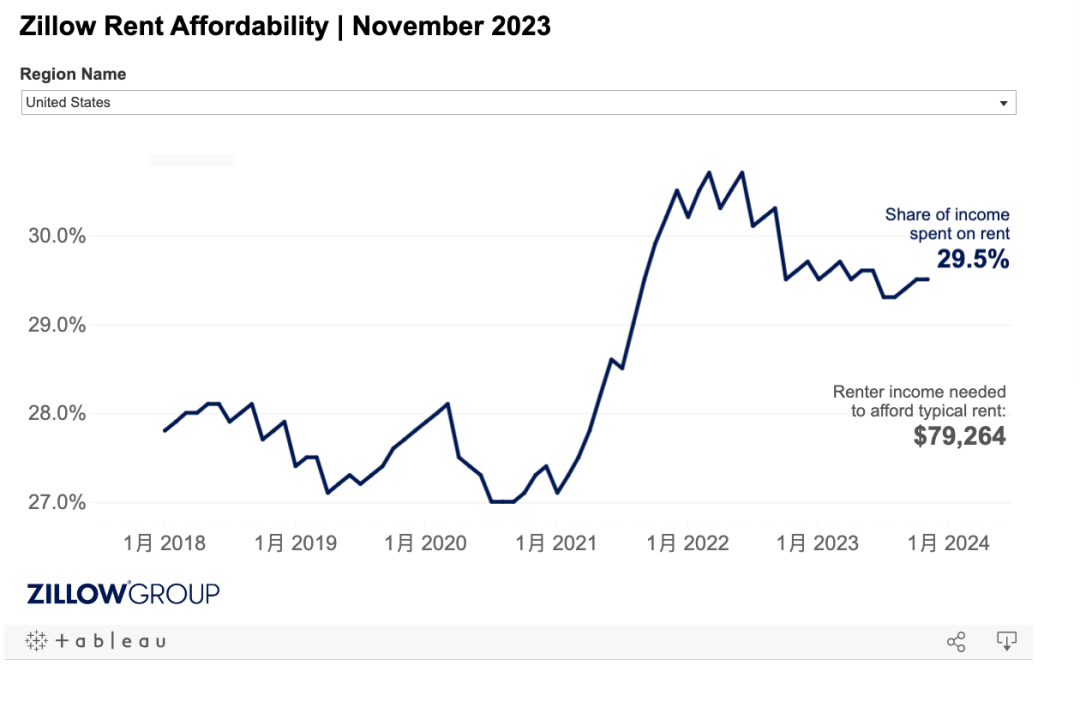
Over the past few months, annual rent growth has remained stable at just below the normal pre-pandemic level of 4–5%. This is good news for tenants who struggled to keep up with rapidly rising rents during the pandemic, but much of the damage to affordability has already been done. Since before the pandemic, the income required for the median renter to comfortably afford rent—spending 30% of income on rent—has increased 40.6% and now stands at $79,264.
Single-Family Rents: Stable
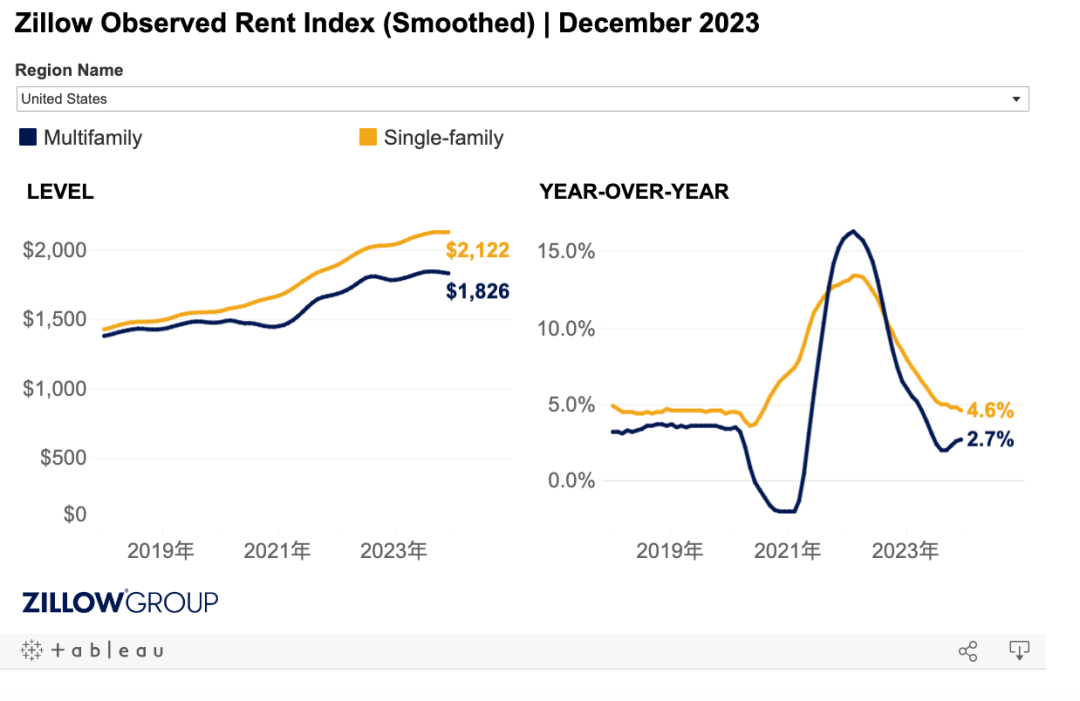
The single-family rental market has received considerable attention since the pandemic, and asking rents in December were $2,122, unchanged from November. These rents have risen substantially—35.7%—since the outbreak of the pandemic, with a year-over-year increase of 4.6%. However, trends were not uniform across all metropolitan areas, with markets such as Boston and Jacksonville recording monthly declines of 1.2% and 0.8%, respectively.
Multifamily Rentals: Feeling the Seasonal Chill
Multifamily rents were also not spared the seasonal downward trend, with asking rents falling to $1,826, down 0.3% from the previous month. These rents have increased 23.1% since the outbreak of the pandemic. The year-over-year increase was 2.7%, with cities such as Providence (6.7%) and Hartford (6.3%) leading the annual gains.
During the pandemic, single-family rents grew much faster than multifamily rents.One of Zillow’s bold predictions for 2024is that “single-family rentals will become the new starter home”—supporting this conclusion and illustrating the impact of the surge in multifamily construction.
Use of Rental Concessions Has Increased in Recent Months
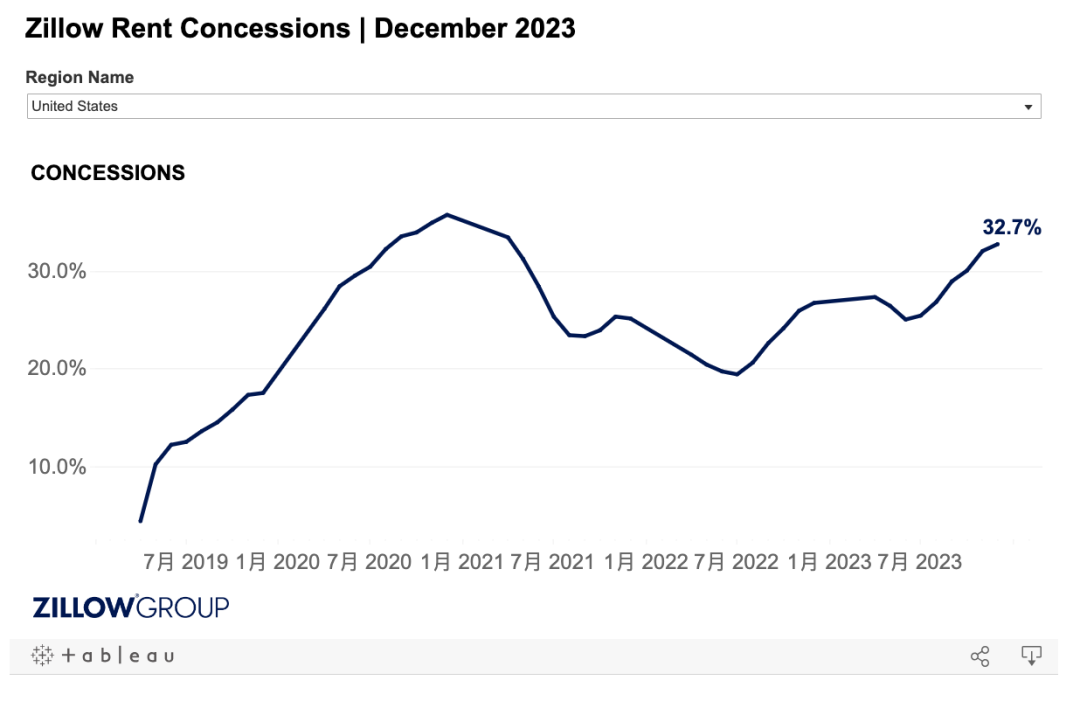
An interesting trend in December was the increased use of rental concessions, with 32.7% of rentals offering Zillow-advertised concessions. This was up 0.7 percentage points from November and a substantial 10.1 percentage points from last year. The increase in concessions was especially common in cities such as Oklahoma City and Memphis, where concessions each increased by 4 percentage points from November to December.
Rental Affordability Conditions
Rental affordability remains a key issue, with the median household needing to spend 29.5% of its income on a new rent in November, the latest available data. This was a slight increase from the previous month but remained above the pre-pandemic average of 28%. Metropolitan areas such as Miami, where renters need to spend 43.4% of their income on rent, and New York, where 39.7% is required, continue to face significant affordability challenges.
To take a closer look at how these trends are playing out across different regions, continue reading for detailed data on regional differences.
Typical Rents (All Rents):
Rents declined month over month in 32 of the 50 largest metropolitan areas. The largest monthly declines were in Jacksonville (-0.8%), San Diego (-0.7%), New York (-0.6%), Denver (-0.6%), and Austin (-0.6%).
Rents were higher than a year earlier in 45 of the 50 largest metropolitan areas. The largest annual rent increases were in Cincinnati (7.1%), Providence (7.1%), Hartford (7.1%), Buffalo (6.3%), and Louisville (6.1%).
Single-Family Rent Trends
Single-family rents declined month over month in 25 major metropolitan areas. The largest monthly declines in single-family rents were in Boston (-1.2%), Jacksonville (-0.8%), Austin (-0.7%), Miami (-0.6%), and Sacramento (-0.6%).
Single-family rents were higher than a year earlier in 49 of the 50 largest metropolitan areas. The largest annual increases in single-family rents were in Cincinnati (9.4%), Hartford (9.1%), Providence (8.9%), Milwaukee (8.7%), and Buffalo (8.1%).
Multifamily Rent Trends
Multifamily rents declined month over month in 30 major metropolitan areas. The largest monthly declines in multifamily rents were in Atlanta (-1%), San Diego (-0.8%), Jacksonville (-0.8%), Baltimore (-0.6%), and Austin (-0.6%).
Multifamily rents were higher than a year earlier in 38 of the 50 largest metropolitan areas. The largest annual increases in multifamily rents were in Providence (6.7%), Hartford (6.3%), Buffalo (6.2%), Boston (6%), and Cincinnati (6%).
Rental Concessions
In 14 of the 50 largest metropolitan areas, the share of rents offering concessions was lower month over month. The largest monthly declines in the share of rents offering concessions were in Cleveland (-3.2 percentage points), Orlando (-2.4 percentage points), San Jose (-2.3 percentage points), Nashville (-1.4 percentage points), and Richmond (-1.2 percentage points).
In 35 metropolitan areas, the share of rents offering concessions was higher month over month. The largest monthly increases in the share of rents offering concessions were in Oklahoma City (4 percentage points), Memphis (4 percentage points), Minneapolis (3.9 percentage points), Indianapolis (2.9 percentage points), and Louisville (2.9 percentage points).
Rental concessions were higher than the same period last year in 47 of the 50 largest metropolitan areas. The largest annual increases in the share of rental listings offering concessions were in Salt Lake City (42 percentage points), Charlotte (24.9 percentage points), Austin (21.5 percentage points), Raleigh (21.5 percentage points), and Dallas (21.2 percentage points).
Rental Affordability
U.S. median households will spend 29.5% of their income on a new rent in November, the latest available data.
In November, the share of income required to pay the typical rent increased 0.1% month over month. Before the outbreak of the pandemic, the share of median household income spent on rent was 28%.
The most affordable metropolitan areas for renters were St. Louis, where renters would spend 20% of their income on a new rent; Minneapolis (20.4%); Salt Lake City (20.4%); Buffalo (20.4%); and Austin (20.9%).
The least affordable metropolitan areas for renters were Miami, where renters spend 43.4% of their income on a new rent; New York (39.7%); Los Angeles (37.3%); San Diego (34.4%); and Riverside (33.8%).
[Disclaimer] Some of the content and images are sourced from Zillow. This article is for sharing purposes only and does not represent any opinions. If your rights have been infringed, please contact us first, and we will address the matter as soon as possible.